
Improving Your Current Custom Manual Wheelchair After a Spinal Cord Injury
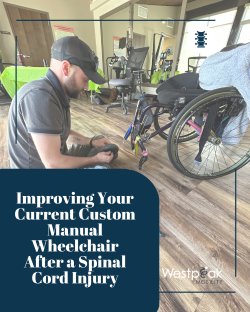
In Part 1, we looked at the wheelchair evaluation and setup process after a Spinal Cord Injury (SCI). But a wheelchair is not a "set it and forget it" device. Bodies change, and a wheelchair that fit perfectly in year one may work against you by year three. Here's why annual follow-ups matter across the typical five-year life of a custom manual wheelchair, and how Complex Rehab Technology (CRT) helps your wheelchair keep up with you.
** below focuses on manual wheelchairs, there are adaptations we can do with power wheelchairs that are not discussed!
Your Body Changes Months and Years After SCI
The first months after injury often bring the biggest changes, but the body keeps adapting for years. Common changes include:
- Muscle and weight changes: Muscle below the level of injury may atrophy, while general weight can shift (to your stomach, hips or bottom). Gaining weight or losing weight can change how your body sits in the wheelchair and how pressure is distributed.
- Changes in strength or motor activation, depending on your diagnosis as complete vs incomplete SCI: You may see that targeted rehabilitation programs, spontaneous recovery, and time help improve strength and gain better control of your muscles; while age, overuse injury, or medical complications can lead to strength deficits, pelvic rotations, or obliquities.
- Re-mapping proprioception: Learning overtime where your “new” body is in space can complement posture and trunk control. As you gain better awareness of where your body is in space, you can adjust trunk and pelvic position for better functional reaching and repositioning.
- Changes in tone and spasticity. Spasticity can increase, decrease, or change pattern over time. These changes can affect posture and how well you stay positioned in your wheelchair.
These changes are normal, and they're exactly why a one-time fitting isn't enough.
Ergonomics of Wheelchair Positioning
Ergonomics is about matching the equipment to the person’s body/function so the body works with less strain. For a custom manual wheelchair, three concepts matter most.
Center of gravity (CoG). Your CoG is the balance point of your weight in your wheelchair. Your weight position is relative to the rear axle which determines how stable the wheelchair feels and how much effort each push takes. Moving the axle forward puts more weight over the rear wheels, which reduces rolling resistance and makes pushing more efficient, but this does make the wheelchair more tippy. Moving it back adds stability but can make the manual wheelchair harder to propel (more weight on the front wheels). The right balance depends on your body, your skills, and your daily environments.
Seat slope. Seat slope (also known as seat dump) is the angle of the seat, usually with the back lower than the front. A bit more slope can help keep your pelvis settled back in the seat, improve trunk support, and reduce sliding. Too much can make transfers and reaching harder. Seat slope also affects where your weight sits, which ties directly back to center of gravity.
Backrest angle and height. Your backrest can come in variety of shapes, sizes, and materials. The curvature and height of backrest depends on musculoskeletal size (aka how long is your torso), motor activation, range of motion, and spasticity. A specific backrest angle can help place you in a good ergonomic position, complementing your center of gravity, or if ill fitted, can impair shoulder movement if the backrest is too tall and impeding scapula movement.
Good positioning does three things:
- Protects shoulder integrity. The right axle position, backrest, and seat height let you push with a long, smooth stroke rather than short, high-effort reaches, reducing repetitive strain.
- Helps you push farther with less effort. An efficient setup means less energy lost to poor alignment.
- Provides smaller turn radius. The more forward an axle is, the back wheels move forward providing a “shorter” the length of the manual wheelchair. This allows you to easily pivot or turn, especially in small spaces.
- Supports comfort and longer sitting tolerance. Proper pelvic support and pressure distribution help you stay comfortable and upright longer.
Applying Ergonomics to Body Changes
This is where follow-ups pay off. Over the five-year life of a wheelchair, small, planned adjustments can keep your setup matched to your body:
- Re-check center of gravity. If your weight, strength, or trunk control has changed, the axle position may need to move to keep the chair both stable and efficient.
- Fine-tune seat slope. If you're falling forward, leaning, or working harder to stay balanced, a slope adjustment can restore support.
- Re-check your back support. Adjusting the height of backrest (vertical) can help reduce potential interference of your scapula movement and provide better lumbar support. Changes the angle of your backrest to complement adjustments to seats slope to ensure comfort sitting for long periods of time.
- Protect your shoulders early. Adjusting the chair before pain develops is far better than after. If you notice new shoulder, wrist, or elbow discomfort, call Westpeak Mobility to set up a quick appointment.
- Plan for the long term. Annual check-ins or any time something changes, help catch issues early and allow time to process decisions about replacement or upgrades.
At Westpeak Mobility, we specialize in Complex Rehab Technology and custom wheelchairs for people living with Spinal Cord Injury. We partner with you and your clinical team not just at delivery, but throughout the life of your wheelchair, so your seating and positioning keep pace with your body. If you've noticed changes in comfort, posture, or how far you can push, contact Westpeak Mobility to schedule a seating and positioning appointment.